
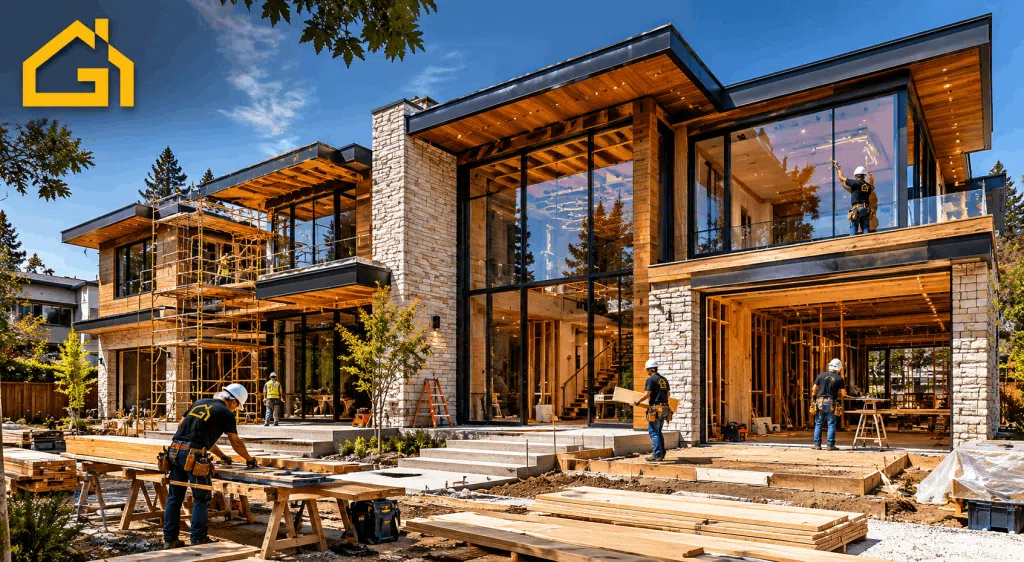
Most fourplex projects in California don’t run into trouble because of bad design or a poor location. They run into trouble because the plan was built on assumptions instead of research. A fourplex in Fresno and a fourplex in San Jose can look identical on paper, same square footage, same unit count, same finish level, and still unfold in completely different ways once permits are pulled and soil reports come back. The difference between a project that stays on track and one that doesn’t usually comes down to how early the real variables were identified, not how polished the design looked at the outset.
Why Location Changes Everything in California Fourplex Construction
The honest starting point is that where you build matters as much as what you build. Labor markets, soil conditions, contractor availability, and how aggressively a jurisdiction enforces its own permitting rules all shape how a project actually plays out, long before the first wall goes up. As a general pattern, the same [custom single-family builds in Silicon Valley](https://goldengategroupinc.com/construction/how-much-does-a-luxury-custom-home-cost-in-silicon-valley/) that pull from the region’s tight skilled-labor pool face many of the same scheduling and staffing pressures that fourplex builders run into.
How Regional Factors Shape a Project
| Region | Labour Market | Permitting Climate | Notable Considerations |
|---|---|---|---|
| San Francisco Bay Area | Tight, strong union influence | Detailed plan review, longer timelines | Soft-story retrofit rules apply broadly |
| Los Angeles / SoCal | Deep but competitive | Varies widely by submarket | Coastal vs. inland zoning can differ sharply |
| San Diego | Strong demand, limited subcontractor bench | Moderate to detailed | Scheduling subcontractors early matters |
| Sacramento | More competitive bidding environment | Generally more predictable | Growing multifamily development activity |
| Fresno / Central Valley | More accessible labour pool | Faster in many cases | Expansive clay soils are common |
| Palm Springs / Inland Empire | Seasonal availability shifts | Moderate | Extreme heat affects scheduling windows |
None of these factors show up on a floor plan, but they all affect how smoothly a build actually goes.
The Fourplex Construction Process, From Site Work to Finishes
Site Work and Foundation
This is where early surprises tend to surface. Grading, compaction, and foundation design depend entirely on what’s underneath the lot. Expansive clay soils, common across much of the Central Valley and the surrounding foothills, often require engineered foundation systems rather than a standard slab, which changes both the structural design and the sequencing of the early build.
Framing
Wood-frame construction (Type V) remains the standard choice for most fourplexes because it’s efficient to build and well understood by California framing crews. Type III construction, more common in mixed-use or urban infill projects, gets used when density, fire separation requirements, or jurisdiction rules call for it. Which type applies to your project is usually decided early, during the design phase, not on site.
Mechanical, Electrical, and Plumbing (MEP)
California adds requirements most other states don’t. Electrical design has to account for mandatory EV charging rough-ins and solar-ready wiring under Title 24. Plumbing design depends heavily on how bathrooms stack across the four units, sharing a wet wall between units is far more efficient than scattering fixtures across the floor plan, and that decision gets locked in during design, long before framing starts.
Exterior and Roofing
Roofing material choice often comes down to wildfire exposure as much as style. Many California jurisdictions now require Class A fire-rated roofing regardless of location. Siding and stucco choices, along with window and door selection, are also shaped by Title 24 energy compliance, which narrows the field of compliant products more than builders coming from other states usually expect.
Interior Finishes
Finish level is as much a durability decision as a design one. Fourplexes built for rental income tend to land in a mid-range finish tier, durable enough to hold up to tenant turnover without the maintenance headaches that come from cutting corners on flooring, cabinetry, or fixtures too early. Going too basic tends to show up as increased maintenance calls within the first few years of operation.
Hidden Technical Challenges That Catch Builders Off Guard
Many of the same surprises show up in single-family custom builds too, and the [patterns are remarkably consistent](https://goldengategroupinc.com/construction/hidden-costs-when-building-a-custom-home-most-homeowners-dont-expect/) regardless of project type. The issues below are the ones that most often derail a schedule that looked solid on paper.
Soil Conditions and Site History
A geotechnical report is required before ground is broken, and what it turns up matters more than the report itself. California’s infill lots are frequently former gas stations, dry cleaners, or light industrial sites, which means a Phase I (and sometimes Phase II) environmental assessment is worth doing early rather than discovering a contamination issue mid-excavation. Expansive clay and high groundwater carry similar risk and are worth flagging during due diligence, not after the lot is under contract.
Utility Connections
| Scenario | What Typically Happens |
|---|---|
| Straightforward infill lot | Standard connection, minimal complications |
| Older neighbourhood, aging mains | May require line upsizing before connection is approved |
| City-required off-site upgrades | Some cities condition approval on upgrading adjacent infrastructure |
Municipal infrastructure in many older neighbourhoods wasn’t sized for added load, and some cities pass that responsibility directly to the developer as a condition of connection.
Title 24 Energy Compliance
California’s energy code is non-negotiable. Solar has been mandatory on new residential builds since 2020, and compliance also touches window performance, mechanical ventilation, and insulation specification. Working with a Title 24 consultant early in design, rather than treating it as a late-stage checkbox, keeps the finished building from needing rework to pass final inspection.
Material and Labour Market Volatility
Many California general contractors now include escalation language in their contracts that passes commodity price swings on to the owner. Understanding how that clause is written, and what triggers it, matters more than the headline bid number. Building schedule flexibility and material lead-time buffers into the contract from the start is standard practice among experienced developers, not an afterthought.
Project Timeline and Carrying Period
A typical California fourplex takes 14 to 22 months from permit approval to certificate of occupancy. Inspection delays, plan check corrections, and supply chain gaps all compound through that window. The longer that stretch runs, the more exposure it creates on the financing side, which is exactly why structuring a construction loan correctly from the start, draws, holdbacks, and interest reserves, is worth planning around rather than reacting to. That structuring conversation is covered in more depth in our [California construction loan guide](https://goldengategroupinc.com/construction/construction-loans-in-california/).
What It Takes Beyond Construction: Design, Engineering, and Permitting
Assembling the Right Design and Engineering Team
A fourplex isn’t a spec home, and it isn’t a project one person can design alone. It requires coordinated drawings from an architect, a structural engineer, and MEP engineers working in parallel rather than in sequence. Skipping that coordination almost always resurfaces later as RFIs, change orders, or failed inspections, which cost far more schedule time to fix than to prevent.
Permitting Realities by Jurisdiction
| City / Region | Typical Plan Check Timeline | Notes |
|---|---|---|
| Los Angeles | Moderate to extended | Fee schedules tied to project valuation |
| San Jose | Moderate to extended | Coordinated review across departments |
| San Francisco | 6 to 12 months in many cases | Detailed plan review; expedited options exist for some projects |
| Inland Empire / Fresno | Generally faster | Less departmental layering |
Plan check timelines carry real schedule risk on their own, independent of construction itself, which is why they belong in the project timeline from day one rather than being treated as a formality.
Impact Fees and Development Requirements
Impact fees are assessed per unit at permit issuance and fund roads, schools, parks, and water infrastructure serving the broader area. They’re non-negotiable in most jurisdictions, though some cities offer partial fee waivers or deferrals for projects that include affordable units under local density bonus provisions. Confirming that with the city before permit submittal, rather than after, is worth the extra step.
Project Management and Risk Planning
Owner-builders who skip professional project management to handle it themselves often find that decision costs more in the long run than it saves. A construction manager or owner’s representative manages the general contractor, tracks the schedule, reviews pay applications, and catches problems before they compound, work that’s difficult to do well from a distance while also running the rest of a business.
New Build vs. Conversion: Which Approach Fits Your Property?
The honest answer depends entirely on the property, and the gap between the two approaches is rarely as clear-cut as it first appears. The right call depends heavily on site and goals, which is why our [Multiplex & Fourplex Construction](https://goldengategroupinc.com/multiplex-fourplex-construction/) team starts every project with a detailed feasibility review before recommending either path.
Where Conversions Tend to Work
A property with a strong existing structure, adequate lot coverage, and utilities already sized for multi-unit use can make conversion the more efficient route. The foundation and framing are already in place, permitting can move faster in jurisdictions that incentivize adaptive reuse, and demolition and site prep are typically lighter. California’s ADU-friendly laws have also made garage and accessory structure conversions considerably more practical in recent years for smaller configurations.
Where New Builds Tend to Win
Older California buildings are often expensive to bring up to current code, and that reality tends to get glossed over in early conversion enthusiasm.
| Upgrade Category | Why It’s Often Required |
|---|---|
| Full electrical rewire | Older wiring frequently lacks proper grounding |
| Plumbing replacement | Galvanized or cast iron lines rarely meet current standards |
| Seismic retrofit | Soft-story or unreinforced masonry structures require it |
| HVAC system installation | Older buildings often lack adequate systems entirely |
| Asbestos and lead abatement | Common in structures built before the 1980s |
Add Title 24 compliance retrofits and ADA accessibility requirements for change-of-use permits, and a conversion that looked like a shortcut can end up carrying most of the complexity of a new build, without the benefit of full design control.
The California-Specific Wrinkle: Soft-Story and Seismic Risk
If an existing structure sits within a soft-story retrofit mandate zone, which covers significant portions of Los Angeles, San Francisco, Oakland, and other cities, conversion projects often face mandatory structural work before any permits are issued for the new use. Los Angeles has had a mandatory retrofit ordinance in place since 2015, and San Francisco’s program has been active even longer. These aren’t optional upgrades. A building that looks like a straightforward conversion on paper can turn into a substantial structural project before interior work even begins.
Side-by-Side Comparison
| Factor | New Build | Conversion |
|---|---|---|
| Predictability of outcome | High | Low to moderate |
| Timeline to completion | 14 to 22 months | 10 to 18 months |
| Design flexibility | Full | Limited by existing structure |
| Code compliance burden | Designed in from the start | Retrofitted after the fact |
| Hidden condition risk | Low | Moderate to high |
| Financing structure | Standard construction loan | Renovation or bridge loan |
The Real Question
The better question isn’t which option wins in general, it’s whether a specific property justifies conversion once a proper inspection and structural assessment are complete. Experienced California developers apply a simple filter: if a conversion requires touching the foundation, replacing all MEP systems, and doing seismic work, ground-up construction usually offers more predictability and lower long-term maintenance exposure. If the structure is post-1980, well maintained, and already close to the footprint needed, conversion is worth serious analysis.
Planning Your Fourplex Project: A Practical Framework
Before anything else, a proper feasibility review answers the questions that actually determine how a project unfolds: what the soil report shows, what the zoning and density bonus rules allow, whether existing utilities can handle four units, and whether the site carries any environmental history worth flagging early.
From there, assembling the right team matters more than moving quickly. An architect, structural engineer, and MEP engineers working in coordination from day one prevent the redesigns and change orders that stall projects further along. Building realistic time buffers into the schedule for plan check, inspections, and approvals keeps expectations grounded, and getting a detailed quantity takeoff and site-specific feasibility assessment from a team that has actually built fourplexes in your market beats relying on general assumptions every time.
Conclusion
Building a fourplex in California in 2025 to 2026 is a serious undertaking, and the projects that go smoothly are rarely the ones with the most polished renderings. They’re the ones where soil conditions, code requirements, permitting realities, and structural risk were identified early and planned around, rather than discovered halfway through construction. Developers who treat soft-story rules, Title 24 compliance, and utility capacity as fixed parts of the plan, not surprises, are the ones who see their projects through on schedule.