
Building a custom home in the Bay Area means navigating more than just permits and blueprints. If your lot sits within a planned community, HOA and CC&R rules will directly shape what you can design, how you can build, and what changes you’re allowed to make in the future. understanding HOA and CC&R rules before you break ground is not optional; it’s the difference between a smooth project and an expensive redesign.
What Are HOA and CC&Rs? A Quick Primer for Homebuyers in the Bay Area
CC&R stands for Covenants, Conditions, and Restrictions. It’s a legally recorded document that stays with the land permanently, meaning you’re bound by its rules the moment you take ownership, regardless of whether anyone walked you through them at closing.
Each of the three components controls a different aspect of your property:
- Covenants: Binding promises about how you maintain and use your property, such as keeping the exterior in good condition or following landscaping standards.
- Conditions: Specific requirements tied to how the property can be built or used, like minimum square footage or setback distances from property lines.
- Restrictions: Outright prohibitions, such as unapproved exterior colors, certain roofing materials, or structures like detached workshops.
The HOA is the organization that enforces these rules. It’s important to understand that the CC&Rs and the HOA are two separate things:
| Category | CC&Rs | HOA |
|---|---|---|
| What it is | The rulebook | The enforcer |
| Form | Legally recorded document | Elected board + committees |
| Who creates it | Developer or community founders | Members of the community |
In the Bay Area, most planned communities have an Architectural Review Committee within the HOA that evaluates any proposed exterior changes or new construction plans before work begins.
Why CC&Rs Matter Before You Buy a Lot (Not After)
Most homebuyers review CC&R rules after they’ve already fallen in love with a lot. By that point, the leverage is gone. You’ve either committed financially or emotionally, and discovering that the community prohibits your preferred architectural style or requires a design aesthetic completely different from your vision puts you in a difficult position.
The smarter approach is to treat the CC&Rs as part of your lot evaluation criteria, not an afterthought. Before purchasing, there are three documents you need to request and review:
- The CC&Rs: The master rulebook governing land use, exterior design, and property modifications.
- Architectural Guidelines: More detailed standards that often specify approved materials, colors, and design elements.
- Any pending amendments: Rules can be updated by the HOA board, and a pending change could affect your project directly.
A few specific questions worth answering before you sign anything:
- Does the community restrict modern or contemporary architectural styles?
- Are there minimum or maximum square footage requirements?
- What exterior materials are approved or prohibited?
- Is there a timeline requirement for completing construction after breaking ground?
In cities like Saratoga and Los Altos Hills, some HOA and CC&R rules are detailed enough to dictate roofline profiles and the visibility of garage doors from the street. Finding this out after you’ve hired an architect and developed a full set of plans is an expensive lesson.
The 7 Design Elements Most Commonly Controlled by HOA Rules
HOA and CC&R rules don’t regulate everything inside your home, but when it comes to anything visible from the street or affecting the neighborhood’s overall appearance, HOA and CC&R rules can be surprisingly detailed. These are the seven areas that come up most often in custom home projects across the Bay Area:
1. Exterior Materials and Roofing
Many communities maintain an approved list of siding, cladding, and roofing materials. Modern choices like metal roofing or fiber cement panels may require special approval or may be outright prohibited in neighborhoods with a traditional aesthetic.
2. Exterior Paint Colors
Some HOAs require homeowners to choose from a pre-approved color palette. Others simply prohibit colors deemed too bold or inconsistent with the neighborhood character.
3. Fence Height, Style, and Materials
CC&R rules typically specify maximum fence heights, approved materials like wood versus wrought iron, and in some cases, whether front yard fencing is permitted at all.
4. Landscaping Standards
Front yard landscaping is often regulated, including requirements for maintained lawn coverage, restrictions on hardscaping, and in some communities, rules around drought-tolerant or native plantings.
5. Garage Doors and Driveways
Street-facing garage doors are a common focus area. Some HOAs restrict the number of garage doors visible from the street or require specific door styles that match the home’s architectural design.
6. Accessory Dwelling Units (ADUs)
This is where California state law and HOA rules can conflict directly. Under Civil Code 4751, HOAs cannot prohibit ADU construction, but they can still regulate placement, height, and exterior appearance.
though if your project includes an accessory dwelling unit, the rules get even more layered, ADU Regulations in Cupertino sit on top of whatever your HOA requires.
7. Visible Smart Home Features
Security cameras, solar panels, and EV charging equipment visible from the street fall under HOA review in many communities. California law protects your right to install solar panels, but the HOA can impose reasonable conditions on placement and visibility.
The HOA Architectural Review Process: Step by Step
Before any construction begins on a custom home within an HOA community, your plans need to go through a formal approval process. This isn’t a quick email exchange. It’s a structured review that can take weeks, and skipping it or starting work before approval is one of the most common and costly mistakes homeowners make.
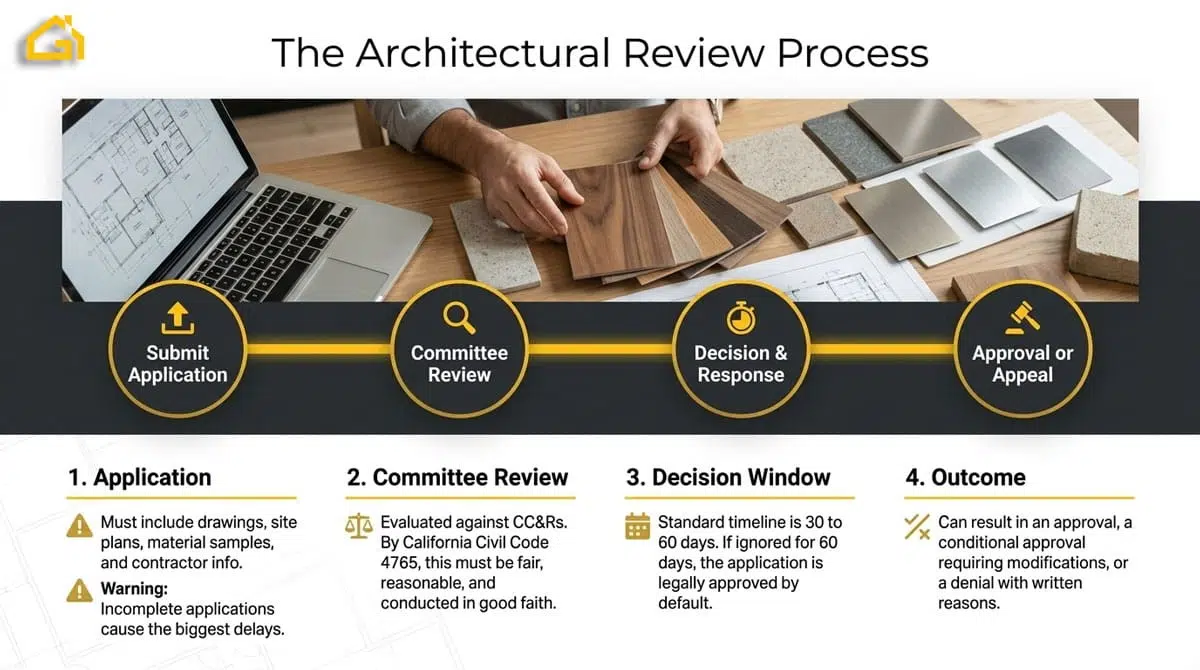
The process typically follows this sequence:
- Submit an Architectural Application
- You’ll need to provide a complete application package that usually includes architectural drawings, site plans, material samples, color selections, and in many cases your contractor’s license and insurance information.
- Committee Review
- The Architectural Review Committee evaluates your submission against the community’s CC&R rules and architectural guidelines. Under California Civil Code Section 4765, this review must be fair, reasonable, and conducted in good faith.
- Decision and Response
- The HOA is required to respond in writing. Most Bay Area associations aim to complete reviews within 30 to 60 days, and that’s separate from Cupertino’s permitting requirements, which run on their own timeline and need to be tracked in parallel.
- Conditional Approval or Denial
- The committee may approve your plans as submitted, approve them with required modifications, or deny them outright with written reasons. A denial is not the end of the road, which is covered in detail in the appeals section later in this guide.
One practical note: submitting an incomplete application is the most common reason for delays. Working with a builder who has experience preparing HOA submissions in your specific community can cut weeks off this process.
California-Specific Rules That Protect Homeowners (Davis-Stirling Act)
Most homeowners assume HOA and CC&R rules are absolute. In California, that’s not entirely true. The Davis-Stirling Common Interest Development Act is the state law that governs all HOAs in California, and it includes several protections that directly limit what an association can enforce against you.
A few of the most relevant protections for custom home projects:
- Solar panels: Under Civil Code 714, an HOA cannot prohibit solar energy systems. It can impose reasonable restrictions on placement and aesthetics, but it cannot block installation entirely.
- ADUs: Civil Code 4751 explicitly prevents HOAs from prohibiting accessory dwelling units. Any CC&R provision that attempts to ban ADU construction is unenforceable.
- Electric vehicle charging: HOAs cannot prohibit EV charging station installation in a homeowner’s designated parking space.
Beyond these specific protections, Davis-Stirling also sets boundaries on how HOA and CC&R rules themselves can be written and enforced:
| Requirement | What It Means for You |
| Rules must be written and adopted properly | Verbal HOA decisions have no legal standing |
| Architectural standards must be clear and objective | Vague rejections based on “neighborhood character” can be challenged |
| Enforcement must be consistent | Selective enforcement against specific homeowners is grounds for dispute |
| Homeowners have the right to a hearing | Before any fine or penalty is imposed, you’re entitled to a formal hearing |
One important clarification: knowing your rights under Davis-Stirling doesn’t mean you should go into the process adversarially. In practice, most disputes with HOAs in the Bay Area get resolved through communication and plan revisions rather than legal action. But understanding where the law draws the line gives you a much stronger position at the negotiating table.
Creative Design Solutions When HOA Rules Feel Limiting
HOA and CC&R rules mostly target what’s visible from the street, and that leaves more room for creative problem-solving than most homeowners expect.
- Work the Interior Toward the Exterior: Floor-to-ceiling windows, open floor plans, and dramatic ceiling heights create a modern high-end feel without triggering any architectural review.
- Find Approved Alternatives for Restricted Materials: If metal cladding or contemporary finishes are prohibited, fiber cement panels or similar products can achieve a clean modern look while meeting the community’s material requirements.
- Use Landscaping as a Design Tool: Strategic planting, lighting, and hardscaping can significantly change how a home reads from the street without touching anything covered by HOA and CC&R rules.
- Talk to the Committee Before You Submit: Most Architectural Review Committees are open to informal pre-submission meetings. Raising potential conflicts before filing saves weeks and avoids the friction of a formal denial.
- Request a Variance When It Matters: If a specific design feature conflicts with CC&R rules but is central to your vision, a formal variance request is an option. California HOAs are required to consider them in good faith.
What Happens If You Violate CC&R Rules During Construction?
Violating HOA and CC&R rules by starting construction without approval, or deviating from approved plans mid-build, triggers consequences that go well beyond a simple fine. In California, HOAs have real legal authority to enforce compliance, and the further along a project is when a violation is discovered, the more expensive the resolution becomes.
The typical escalation looks like this:
- Written warning: The HOA notifies you of the violation and gives a deadline to cure it.
- Fines: Daily or recurring fines begin if the violation isn’t addressed. Under Davis-Stirling, fines must follow a schedule that was properly adopted and disclosed to homeowners.
- Stop-work order: For active construction violations, the HOA can seek a court order halting all work on the project.
- Lien on the property: Unpaid fines can result in a lien being recorded against your property, which affects your ability to sell or refinance.
- Mandatory removal or reversal: In serious cases, a court can order that an unauthorized structure be modified or demolished entirely at the homeowner’s expense.
The removal scenario is rare but it does happen, and it’s been documented in California cases involving unpermitted additions and structures built in violation of recorded CC&Rs. No design decision is worth that outcome.
The most effective protection is a builder who understands HOA and CC&R rules in your specific community and treats HOA and CC&R rules as a non-negotiable part of the process, not an administrative inconvenience.
How to Appeal an HOA Architectural Denial in California
A denial from the Architectural Review Committee is not the end of your project. California law gives homeowners a structured path to challenge architectural decisions, and a well-prepared appeal frequently leads to a different outcome.

The first step is to get the denial in writing with specific reasons. HOAs are legally required to provide written justification, and vague rejections based on subjective concepts like “neighborhood harmony” are not enforceable under Civil Code 4350. Once you have the written denial, compare each stated reason against the actual CC&R rules and architectural guidelines word for word. HOAs sometimes deny applications based on informal preferences or unwritten standards that have no legal standing.
From there, the escalation path under California’s Davis-Stirling Act follows a defined sequence:
- Internal Appeal: Submit a formal written appeal to the full HOA board, directly addressing each reason for denial with supporting documentation.
- Internal Dispute Resolution (IDR): If the board upholds the denial, you can request an informal face-to-face meeting with an HOA representative. This step is required before any legal escalation.
- Civil Mediation: If IDR doesn’t resolve the dispute, mediation through a neutral third party is the next option.
- Legal Action: As a last resort, homeowners can pursue the matter in small claims or superior court depending on the nature of the claim.
One thing worth knowing: California HOAs lose a meaningful number of architectural disputes when the denial lacks a clear basis in the governing documents and the homeowner arrives prepared. The process is more balanced than most people assume.
Conclusion
HOA and CC&R rules are a permanent part of the landscape in many Bay Area communities, and the homeowners who navigate HOA and CC&R rules successfully are the ones who engage with them early and strategically. From reviewing governing documents before purchasing a lot, to understanding your legal protections under California’s Davis-Stirling Act, to working with a builder who knows the approval process inside out, every step covered in this guide comes down to one principle: preparation beats reaction to working with a custom home design team who knows the approval process inside out. The more you understand how HOA and CC&R rules work, the more control you retain over the home you’re trying to build.