
Understanding ADU regulations in Cupertino starts with one reality: housing demand is high and the lots are already paid for. But the rules governing what you can build are split between California state law and Cupertino’s local ordinance, and they don’t always align. This guide covers ADU regulations in Cupertino exactly as they stand in 2026, including size limits, setbacks, permit steps, and what actually drives the cost of a project.
If you’re ready to move from planning to building, our Construction team has handled ADU projects across Cupertino and knows exactly where these projects stall — and how to keep them on track.
What Is an ADU and Why Cupertino Homeowners Are Building Them?
An accessory dwelling unit is a self-contained living space built on the same lot as an existing single-family or multifamily home. It has its own entrance, kitchen, and bathroom — functionally a complete home, just smaller and on shared land.
There are three types that matter under Cupertino ADU rules:
- Detached ADU: A standalone structure in the backyard, fully separate from the main house.
- Attached ADU: An addition to the primary home that shares at least one wall.
- JADU (Junior ADU): Converted from existing interior space (like a bedroom or garage) and capped at 500 sq ft.
The reasons homeowners build them break down pretty cleanly. Rental income is the biggest one — a finished detached ADU in this market can generate solid, reliable monthly income on its own. Some are housing a parent or an adult kid who can’t afford the Bay Area independently. Others are simply adding to a property that’s already worth a lot.
The lot is there. The infrastructure is there. What you build, and how, is the only real variable.
Types of ADUs Allowed in Cupertino
Not every lot qualifies for every type of ADU. What you can build depends on your property size, zoning, and what’s already on the lot. Here’s how each type breaks down under ADU regulations in Cupertino.
Detached ADU
This is the most common choice — a standalone structure in the backyard, completely separate from the main house. It can be purpose-built from the ground up or constructed over a garage.
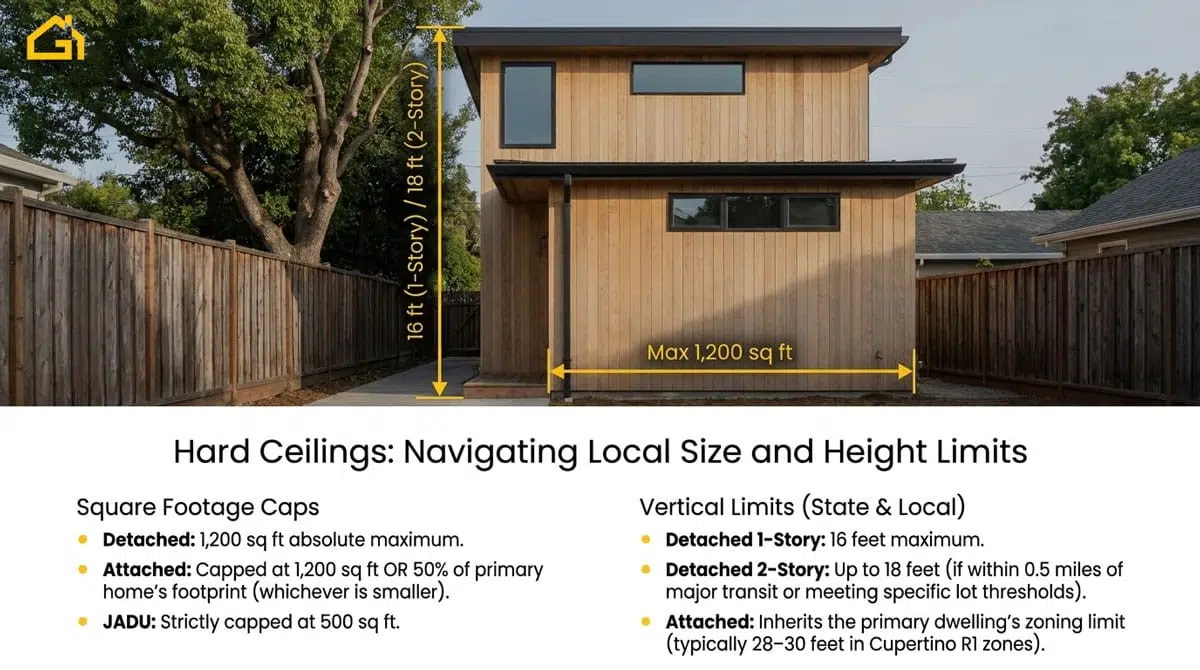
Maximum size is 1,200 sq ft, but if your primary home is smaller than 800 sq ft, Cupertino must allow a detached ADU of at least 800 sq ft regardless of lot size. That’s a state-level protection that overrides local rules.
Height limit is 16 feet for a one-story unit. Two-story detached ADUs can go up to 18 feet under specific conditions, more on that in the next section.
Attached ADU
An attached ADU shares a wall with the primary residence. It functions the same way as a detached unit — separate entrance, kitchen, bathroom — but is structurally connected to the main home.
Size is capped at 1,200 sq ft or 50% of the primary home’s square footage, whichever is less. So if your house is 1,800 sq ft, your attached ADU tops out at 900 sq ft.
Junior ADU (JADU)
A JADU is carved out of existing interior space. A large bedroom, a converted garage, part of a basement — any enclosed area within the footprint of the primary dwelling can qualify. Maximum size is 500 sq ft.
A few things make JADUs different from standard ADUs:
- They can share a bathroom with the main house (an efficiency kitchen is still required)
- They require an owner-occupancy agreement recorded against the property
- They cannot be combined with a full ADU on the same lot unless the full ADU is detached
JADUs are cheaper to build precisely because you’re not adding new square footage — you’re reclassifying space that already exists.
Garage Conversion
Technically a subcategory of either an attached ADU or a JADU depending on the garage’s connection to the house, but worth separating out because it’s one of the most cost-effective paths available under ADU regulations in Cupertino.
Converting an attached garage to living space doesn’t require you to replace the lost parking. California state law prohibits local governments from requiring parking replacement when a garage is converted to an ADU. That rule applies in Cupertino.
One limitation: the conversion is bounded by the existing structure. You can’t expand the footprint as part of a straight conversion — that crosses into attached ADU territory and triggers different requirements.
Cupertino ADU Size and Height Rules (2026)
Size limits are where ADU regulations in Cupertino catch a lot of homeowners off guard. The numbers look straightforward on paper, but the interaction between state minimums and local caps creates some edge cases worth knowing before you start drawing plans.
The Core Size Limits
| ADU Type | Maximum Size | Notes |
|---|---|---|
| Detached ADU | 1,200 sq ft | State floor of 800 sq ft applies if primary home is under 800 sq ft |
| Attached ADU | 1,200 sq ft or 50% of primary home | Whichever is less |
| JADU | 500 sq ft | Must be within existing primary dwelling footprint |
| Garage Conversion | Existing structure size | Expanding footprint changes the classification |
The 800 Square Foot Guarantee
This is one of the most important protections built into ADU regulations in Cupertino that most homeowners overlook. Under California state law, if your primary home is smaller than 800 sq ft, you are still entitled to build a detached ADU of at least 800 sq ft. Cupertino cannot deny that based on lot coverage or setback rules alone.
For smaller lots — and Cupertino has plenty of them — this provision is often the difference between a buildable project and one that gets blocked at the planning counter.
Height Rules
ADU regulations in Cupertino set height limits that follow state guidelines with some local conditions attached.
Detached ADU:
- One-story: 16 feet maximum
- Two-story: up to 18 feet, permitted when the ADU is within half a mile of a major transit stop or when the lot meets specific size thresholds
Attached ADU:
- Must comply with the height limits of the primary dwelling’s zoning designation
- In most single-family zones in Cupertino, that means 28 to 30 feet, so attached ADUs rarely hit a ceiling issue
JADU:
- Height is not a separate consideration — the unit exists within the primary structure, so it’s governed by the primary home’s existing height
A Note on Lot Coverage
Under ADU regulations in Cupertino, the general lot coverage limit for residential zones is 45%. That means all structures combined — house, garage, ADU — cannot cover more than 45% of the lot.
There’s a catch: California law requires cities to allow at least an 800 sq ft ADU even if doing so pushes you over that coverage limit. The state minimum overrides the local percentage cap in those cases. It does not, however, override setback requirements — those still apply.
Setback, Lot Coverage & Zoning Requirements
Setbacks are where many Cupertino ADU projects either get shaped or get stopped. Understanding these rules early saves you from designing a unit that has to be relocated, or scaled down, after you’ve already paid for drawings.
What Is a Setback?
It’s the minimum distance your ADU must maintain from the property line. ADU regulations in Cupertino follow California’s setback standards, which are more permissive than what the city used to enforce under its older local ordinance.
Current Setback Requirements
| Location | Minimum Setback |
|---|---|
| Rear property line | 4 feet |
| Side property line | 4 feet |
| Front setback | Must meet primary dwelling’s zoning requirement |
| From primary dwelling | No minimum (attached ADU can share a wall) |
The 4-foot rear and side setbacks come from state law — Cupertino can’t require more. Front setbacks follow your zoning designation’s standard requirement, typically 20 feet in R1 zones.
If your ADU sits close to a property line or adjacent structure, fire-rated wall construction may be required. And if your primary home has sprinklers, the ADU needs them too.
ADUs are permitted by right in all single-family zones — no hearings, no variances. Multi-family properties can typically add one detached ADU per lot plus one JADU per existing unit.
Lot coverage is capped at 45%. Most standard Cupertino lots handle a 600 to 800 sq ft ADU without hitting that limit. If you do exceed it, the state’s 800 sq ft minimum guarantee is your fallback, but only for that threshold, not for a larger build.
Do You Need Owner-Occupancy in Cupertino?
For years, owner-occupancy was one of the biggest friction points in ADU regulations in Cupertino and across California. Cities could require you to live on the property before issuing a permit, which effectively blocked investors and made financing harder.
That changed.
Under SB 13, California suspended the owner-occupancy requirement for ADUs through January 1, 2025. After that date, cities were allowed to reinstate it, but only for JADUs, not for standard ADUs.
Here’s what that means in Cupertino today:
- Standard ADU (detached or attached): No owner-occupancy requirement. You can build, rent, and not live on the property.
- JADU: Owner-occupancy is required. An owner-occupancy agreement must be recorded on title before a permit is finalized. If you sell the property, the new owner takes on that obligation.
One practical note: even without an owner-occupancy rule for full ADUs, some lenders still factor occupancy into their underwriting when you’re financing the build. That’s a lending question, not a zoning one, but worth knowing before you start.
Permit Process: Step by Step
ADU regulations in Cupertino mean building isn’t a one-stop trip to City Hall. The process involves multiple departments, and the sequence matters. Getting it out of order adds weeks. Cupertino’s permitting system has its own quirks — Everything to Know About Building Permits in Cupertino breaks down the full process if you want to go deeper before submitting plans.
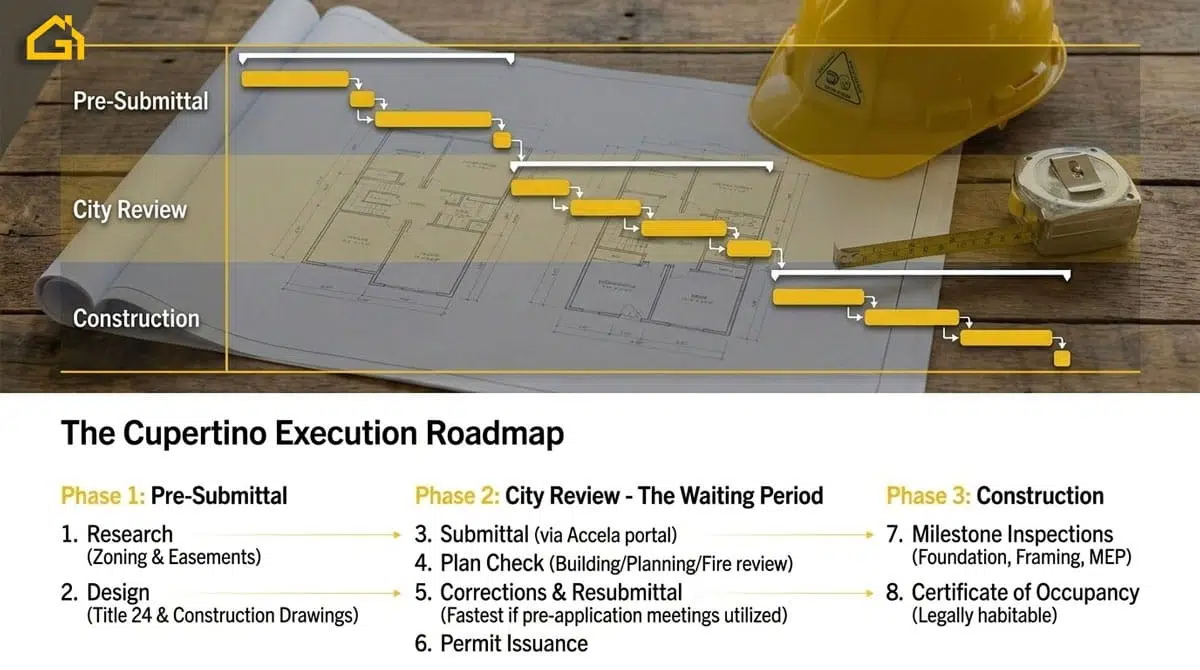
Here’s how it typically flows:
1. Pre-Application Research
Before submitting anything, confirm your lot’s zoning, utility easements, and whether any deed restrictions apply. Cupertino’s Planning Division can answer zoning questions informally, and this step can save significant time later.
2. Design and Plan Preparation
Hire a licensed architect or designer to prepare construction drawings. Plans need to meet Cupertino’s building code, Title 24 energy compliance, and any fire separation requirements based on proximity to property lines.
3. Plan Check Submittal
Submit plans through Cupertino’s online permitting portal (Accela). Required documents typically include:
- Site plan showing setbacks and lot coverage
- Floor plans and elevations
- Title 24 energy calculations
- Structural calculations (if applicable)
4. Plan Check Review
This is where most of the waiting happens. The Building Division reviews for code compliance; the Planning Division checks zoning. First-round comments usually come back within 2–4 weeks for straightforward projects. Complex designs or those requiring Fire Department sign-off take longer.
5. Corrections and Resubmittal
Almost every project gets at least one correction notice. Address the comments, update the drawings, and resubmit. Second rounds are faster, typically 1–2 weeks.
6. Permit Issuance
Once approved, you pay permit fees and receive your building permit. Construction cannot begin before this step.
7. Construction and Inspections
Your contractor schedules inspections at key milestones: foundation, framing, rough mechanical/electrical/plumbing, insulation, and final. Each inspection must be approved before moving to the next phase.
8. Certificate of Occupancy
After the final inspection passes, the city issues a Certificate of Occupancy (or final sign-off). The ADU is now legally habitable and can be rented.
How Long Does ADU Approval Take in Cupertino?
Most homeowners underestimate how much ADU regulations in Cupertino affect the timeline. The construction itself is often faster than getting the permit.
For a straightforward detached ADU with no complications, expect roughly 4 to 6 months from first submittal to permit issuance. Factor in design time before that, and you’re looking at 6 to 9 months before a shovel hits the ground.
A few things that stretch the timeline:
- Multiple correction rounds due to incomplete drawings
- Fire Department review for units close to property lines
- Utility connection upgrades (especially older lots in Cupertino)
- Custom or two-story designs with structural complexity
JADUs and simple garage conversions typically move faster, sometimes reaching permit issuance in 8 to 12 weeks if the drawings are clean on the first submittal.
California state law requires cities to approve or deny ADU applications within 60 days of receiving a complete application.
One practical tip: Cupertino offers pre-application meetings with Planning staff. Using that window to get informal feedback before a formal submittal can eliminate an entire correction round.
What Shapes ADU Costs in Cupertino
Building under ADU regulations in Cupertino, in one of the most expensive parts of the Bay Area, is never going to be cheap. But the gap between the different ADU types is wide, and it comes down almost entirely to what you build and how much of the existing structure you can reuse.
A garage conversion sits at the low end of that range, because the structure already exists — you’re paying for interior work, insulation, electrical, plumbing, and permits, not a new foundation or framing. A JADU carved out of existing interior space costs even less for the same reason: you’re reclassifying space rather than adding it.
A detached ADU is a different story. It requires its own foundation, exterior envelope, and mechanical systems built from the ground up, which puts it at the top of the range regardless of size. Push toward the larger end of what’s allowed, or add a second story, and the project starts approaching the scope of a small standalone home — second story additions in Cupertino run into a lot of the same dynamics.
For a full breakdown of what actually drives luxury-spec ADU costs in this market — by size, structure type, and finish level — our luxury ADU cost guide walks through it in detail.
Conclusion
Building an ADU in Cupertino is genuinely one of the more straightforward paths to adding value and income to your property, once you understand the rules. ADU regulations in Cupertino sit at the intersection of state law and local code, and knowing which one governs each decision saves you time, money, and frustration. The fundamentals are clear: respect your setbacks, stay within size and height limits, pull the right permits, and plan the finish level realistically. Do that, and ADU regulations in Cupertino stop being an obstacle and start being the framework that makes your project work in one of the most competitive rental markets in the country.